

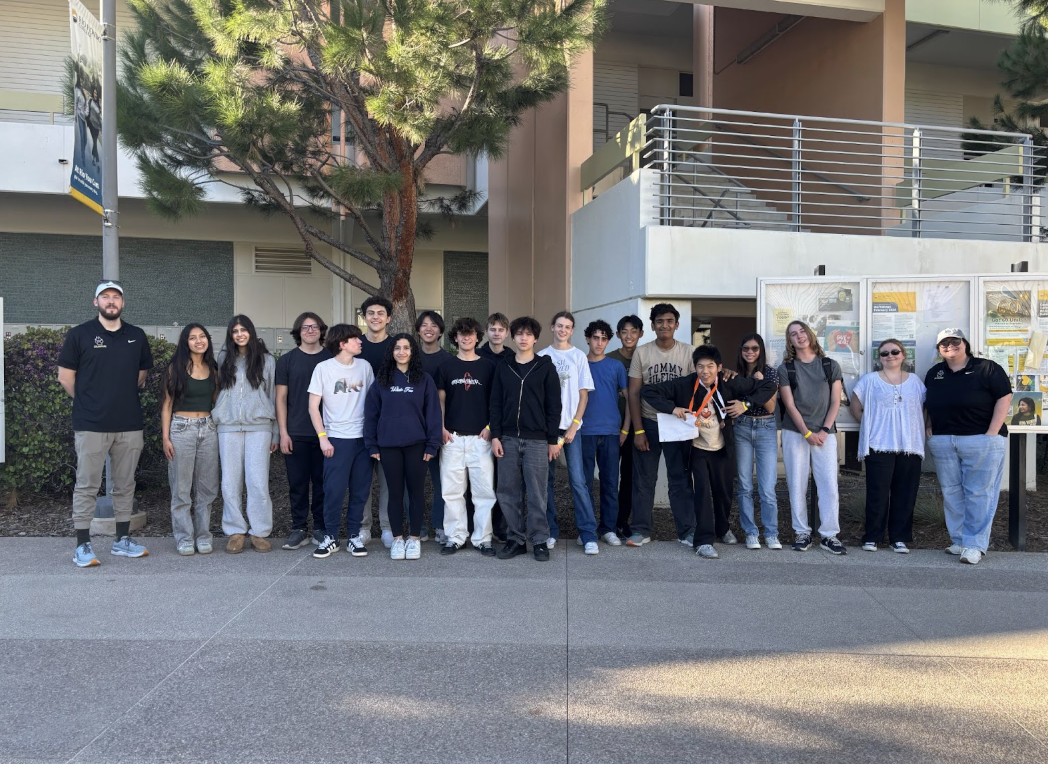
On February 28, Calabasas High sent two Science Olympiad teams to compete in the annual Los Angeles Regional Tournament at Rio Hondo College, where they participated in a range of academic and engineering events, competing against over 60 schools. The team performed better overall than previous years, and had strong competition to face.
Science Olympiad, a national competition for high school students, challenges participants in diverse STEM activities, including chemistry, physics, engineering, and biology. Each team includes up to 15 students with a limited number of seniors. Competitions combine written exams, hands-on lab work, and pre-built projects.
Led by club presidents Nikita Mikhailov and Alexander Flom, the team met weekly to prepare for its wide range of events.
“They participated in almost all of them. There’s one called the bungee drop, where you drop the bungee to a certain height without hitting the ground. We had entomology, which is a test on bugs, and the students Jordan Lin and Angelina Hiuriono ranked fifth. They also had something called a robot tour where they had to build a robot, and it had to go through a certain track,” said Emily Sneed, the teacher advisor.
The students also tackled more mechanical builds, such as the hovercraft challenge, the rubber-band helicopter, and the electric vehicle event.
While rigorous, Angelina Hiuriono, who ranked fifth place in her event, noted that working together can be a rewarding experience that strengthens connections.
“There’s a lot of nice people there— they’re my friends outside of Science Olympiad, and it’s a lot more fun competing with them,” said Hiuriono. “I mean, we study a lot, but it’s still fun to do.”
At the Rio Hondo College competition, Calabasas High’s team placed 18th overall, earning a higher score than last year.
Because of the complex and technical nature of the events, students must prepare intensely to excel.
“I do practice tests online and look at the official website for Science Olympiad. I make my own notes on paper, and some of the events let you have a cheat sheet,” said Hiuriono.
Besides a higher overall score, Sneed notes the team has also improved in other ways.
“Last year, the students were still trying to figure out what they needed to do. This year, they were more on top of it, trying to be prepared ahead of time.”
She also witnessed an increase in team unity, an integral part of competing successfully.
“I would love to place top ten and go to state at least once,” said Sneed.
Trial and error is often a part of the process, where even carefully designed projects can fail at any moment.
“This year, my helicopter build broke, and we had to fix it several times, but it ended up still working. So work with what you’ve got,” said Hiuriono.
The LA circuit remains immensely competitive, making advancing a significant challenge for any team. The Science Olympiad teams hope to return to the tournament next year and eventually advance to the Southern California State Tournament.