

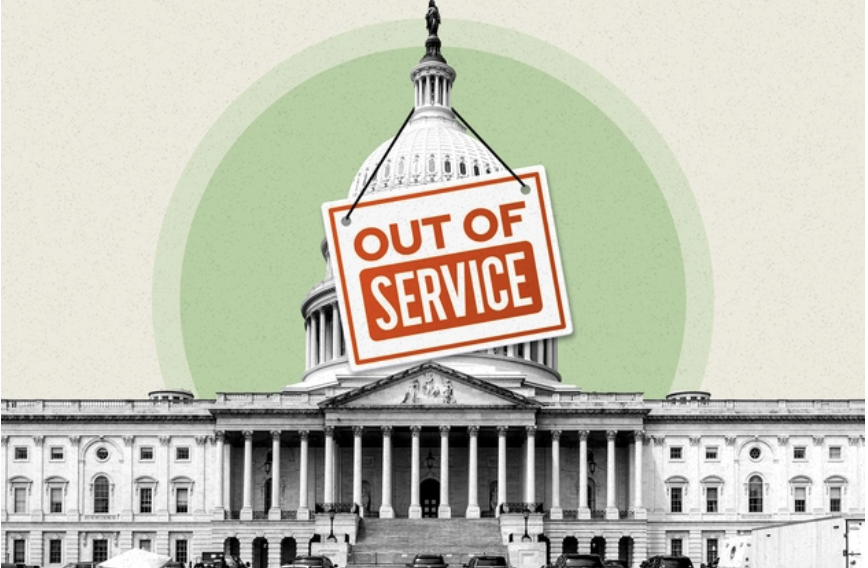
A bitter budget standoff in Washington led to the longest federal government shutdown in U.S. history, lasting 43 days from October 1 to November 12. Many government offices and services were closed, national parks locked down, and hundreds of thousands of federal employees either furloughed or working without pay. Americans watched the nation’s capital grind to a halt, which was a stark reminder of the real-world cost of political gridlock.
The shutdown began when federal funding expired at midnight on October 1st. House Republicans, led by Speaker Mike Johnson and backed by President Donald Trump, demanded deep spending cuts, including rolling back Affordable Care Act subsidies, while Democrats refused to compromise. Within hours, national parks and visitor centers locked their doors, and federal offices went dark. Essential workers such as air traffic controllers, TSA agents, and lab technicians remained on the job, working long hours without pay, while furloughed employees scrambled to cover rent and bills, sometimes relying on credit unions or food banks. SNAP (Supplemental Nutrition Assistance Program) benefits and other welfare programs slowed, affecting millions of families, while military personnel and teachers on federal installations waited anxiously for missed paychecks. Charities stepped in to provide meals, highlighting the personal toll on those whose livelihood depends on federal funding.
As the weeks wore on, the shutdown’s effects rippled across the economy. Airlines canceled flights and training due to controller shortages, while national parks lost roughly $1 million per day in visitor fees. Obamacare premiums rose without federal subsidies, and passport, visa, and loan processing slowed nationwide. Court filings, research grants, and federal inspections were delayed. The standoff hardened in late October, even as public frustration grew, media coverage intensified, and a billionaire donor stepped in to ensure military pay. States filed lawsuits over cuts to food assistance, and union leaders demanded action, while lawmakers held talks that repeatedly stalled.
After the midterm elections on November 5, a compromise finally emerged. Congress passed full-year funding for key departments and extended other agency budgets through January 2026, guaranteeing back pay and preventing mass layoffs. The House approved the measure 222-209, the Senate followed, and President Trump signed the bill on November 12. Federal offices reopened, employees received back pay, and services gradually resumed, but the disruption left lasting reminders of the shutdown’s reach. There was mail and passport backlogs, stalled grants, and delayed loan approvals affecting Americans well beyond Washington.
“I think the shutdown exposed how much regular people get caught in political fights. It’s not just numbers and bills, it is everyday life that is disrupted,” said CHS junior Isabel Beddows.
The shutdown hit ordinary Americans hardest. Nearly 900,000 federal employees missed paychecks, while essential workers endured mandatory overtime without compensation. Families relying on SNAP and TANF (Temporary Assistance for Needy Families) faced immediate hardships, sometimes skipping meals or standing in line at food banks. Military families, teachers on federal installations, and social-service workers struggled to pay bills. Small businesses, particularly airport restaurants, taxi services, and federal contractors, lost revenue, and communities near national parks saw campgrounds empty, lodges close, and shops shuttered.
Even daily conveniencies, such as postal deliveries and student loan processing, slowed, affecting families nationwide. Frontline workers, low-income families, and small communities bore the brunt, while lawmakers scrambled under mounting pressure. Economists estimate the shutdown reduced U.S. economic output by $11-15 billion. Factories lost hours, farm payments and permits were delayed, and government contractors paused projects.
Tourism and local businesses near federal offices saw dramatic drops in customers, while airlines and cruise lines lost millions in canceled flights. Retailers near closed monuments reported weekly sales down sharply, and even state governments had to dip into reserves to maintain local services. Analysts warned that the shutdown would subtract a fraction of GDP growth, with long-term effects on households and communities that depend on federal programs.
“Watching the news about the shutdown was one thing, but knowing people are struggling made it personal. It wasn’t just politics, it was real people struggling,” said CHS junior Shaya Bakhshi.
At 43 days, the 2025 shutdown surpassed the 2018-19 Trump-era closure of 35 days and the 1995-96 Clinton-era shutdown of 21 days. About 900,000 workers missed paychecks, more than in previous shutdowns, and unprecedented interventions, including a private donor paying troops, highlighting the severity. Public blame fell largely on Trump and congressional Republicans, reflecting a deeply polarized climate. Compared with past shutdowns, more employees missed multiple paychecks, and major cities with high concentrations of federal workers experienced spikes in local unemployment, emphasizing the growing human and economic cost of stalled governance.
Public frustration was widespread. Polls showed Democrats gaining popularity as voters blamed Republicans for the impasse. Demonstrations appeared at airports, museums, and union halls, while election results in Virginia, New Jersey, and other states reflected voter anger. Both parties claimed partial victories but trust in Congress and the White House suffered, leaving many Americans relieved the government reopened but wary of future shutdowns. Lawmakers have since proposed reforms, including automatic funding continuation and simultaneous consideration of all spending bills, while debates over the Senate filibuster resurfaced. The 2025 shutdown serves as a reindeer that partisan deadlock can halt routine services, disrupt families, and stall the economy.